
1 How separate failures become a single life story
The events that shape a person's life rarely share one simple explanation.
A romantic breakup may result from emotional incompatibility. Professional difficulties may reflect macroeconomic downturns or limited local employment prospects. Financial losses may follow unexpected circumstances or developments beyond individual control. When navigating prolonged setbacks or repeated rejections, addressing work and employment difficulties can help untangle objective socioeconomic barriers from personal feelings of defeat.
Yet people do not always preserve these distinctions when remembering their experiences.
When several painful events occur close together, their emotional impact can create a sense of continuity between them. What connects the events is the distress they produce rather than a common causal root.
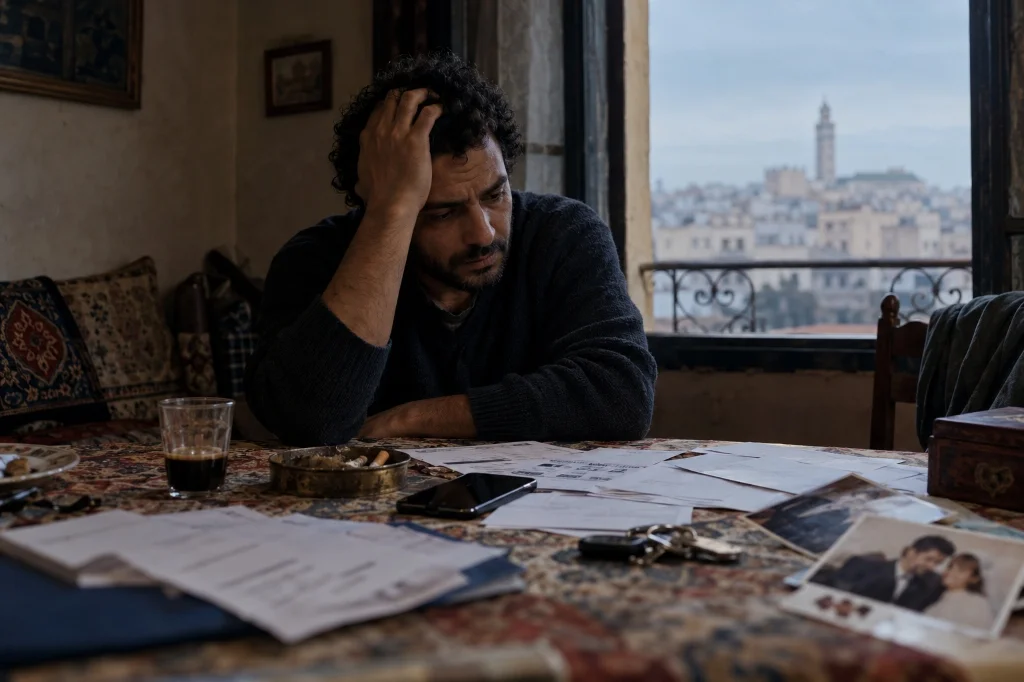
Consider someone who loses a job, experiences the breakdown of an important relationship, and subsequently suffers a financial setback.
Each event has its own circumstances. But after months of disappointment, the individual may begin to interpret them as parts of a single, coherent narrative.
At first, the person thinks, « That opportunity did not work out. » Later, the conclusion becomes more personal: « Things never work out for me. » Eventually, it develops into an overarching judgment: « My whole life is cursed by bad luck. »
This progression marks a decisive psychological shift.
The setback ceases to be an event situated in a specific context. It becomes a supposed attribute of the person, and then a universal rule governing their life.
New experiences are subsequently interpreted through this rigid frame.
A delayed response to a job application feels like an immediate rejection. An ordinary disagreement with a partner seems to announce impending abandonment. A minor obstacle at the beginning of a venture becomes definitive proof that another failure is approaching.
The belief in l'aks gradually organizes separate experiences into a unified story in which disappointment is expected and success appears unnatural.
2 Why painful memories become more convincing than positive experiences
Human memory is neither an objective archive nor an impartial record of everything that has happened.
What people remember is influenced by emotional intensity, current concerns, and the meanings attached to earlier experiences.
Someone convinced that they are unlucky easily recalls moments of rejection, humiliation, disappointment, or loss. Periods of stability and smaller successes often receive far less attention in their personal narrative.
This process does not necessarily involve a conscious decision to ignore positive experiences.
Emotionally distressing events leave particularly vivid psychological traces. Recalling them reactivates the frustration, sadness, or shame associated with the original experience.
Another important mechanism is confirmation bias.
Once people adopt a belief about themselves or the world, they tend to notice information that supports it and give less weight to information that contradicts it, treating counterexamples as mere anomalies.
Imagine someone who has applied for many jobs. Several applications were rejected, but some resulted in encouraging interviews, and others produced offers that were ultimately unsuitable.
If the person already believes that misfortune follows them, the rejections will dominate their account of the entire period.
The other outcomes lose their weight and are dismissed.
A painful breakup during the same period is then added to the ledger.
What began as a collection of separate experiences becomes a single conclusion: life is determined to defeat me.
Memory plays an active role in this process, actively constructing the story through which the individual interprets new experiences and anticipates future outcomes.
3 When coincidence begins to look like a curse
The human mind constantly searches for patterns.
Recognizing connections between events is essential for learning, anticipating danger, and making decisions. However, this capacity also makes individuals vulnerable to perceiving causal links where only coincidence exists.
Imagine that someone's car breaks down on the morning of an important job interview. Later that day, they receive troubling family news. A week afterward, they encounter an unexpected financial loss.
The accumulation may feel too unfavorable to be accidental.
The person begins asking why so many adverse events are happening at once.
Emotional distress increases the urgency of finding an explanation. Accepting that several painful and unrelated problems simply collided within a short period feels psychologically unsatisfying.
A single explanation offers immediate coherence.
The idea of persistent bad luck brings together events that would otherwise require separate, nuanced explanations.
Within certain cultural environments, this interpretation easily connects to witchcraft, the evil eye, supernatural displeasure, or invisible forces.
In Morocco, l'aks provides a familiar linguistic vehicle for making this transition.
The expression can initially describe an unfavorable outcome. But when someone states « Andi l'aks », misfortune takes on the character of an enduring, personal condition.
There is a vital distinction between saying that events went wrong and believing that an unseen influence causes everything to go wrong.
The first describes an experience. The second offers a totalizing theory of one's existence.
Once established, that theory treats every new difficulty as fresh confirmation of its truth.
4 Losing the sense of control over one's life
Psychological well-being is closely connected to the belief that personal actions can influence outcomes.
People need some reasonable confidence that effort, preparation, learning, and changes in behavior can improve their circumstances.
Repeated setbacks undermine this confidence, especially when individuals feel that nothing they do makes any difference.
Someone may spend years searching for stable employment without success. Another may repeatedly attempt to repair a difficult family relationship without seeing any progress. A third may invest considerable resources in a venture that collapses due to broader economic pressures.
Eventually, the question shifts from « How can I succeed? » to « What is the point of continuing? »
This experience aligns closely with learned helplessness, a concept developed in psychology to explain how repeated exposure to uncontrollable situations diminishes motivation and initiative.
This emotional exhaustion and gradual withdrawal closely parallel patterns observed in depression and emotional distress, where despair and fatigue cast a pervasive shadow across everyday perceptions.
The cultural experience of l'aks introduces an additional dimension.
Some individuals do not merely feel ineffective; they perceive an active, adversarial force working against them.
Their inability to control outcomes is taken as evidence of external opposition.
This belief directly alters behavior.
Fear of failure discourages initiative. Expectations of rejection encourage emotional withdrawal. The conviction that a project is doomed weakens perseverance in the face of ordinary obstacles.
These reactions reduce the individual's chances of achieving favorable outcomes.
When new disappointments occur, they are interpreted as proof of bad luck.
A vicious cycle forms between perceived helplessness, negative expectations, avoidance, and disappointing results.
5 Unconscious conflicts and the repetition of painful experiences
Some personal histories contain patterns that cannot be fully explained by memory bias or negative expectations alone.
A person may genuinely desire a stable relationship yet repeatedly choose partners who are emotionally unavailable or volatile.
Another may express an ambition for professional success while systematically postponing essential actions whenever a real opportunity arises.
A third may complain of being undervalued while maintaining interactional styles that provoke conflict.
These patterns invite an examination of psychological conflicts that operate outside conscious awareness.
In my research on hadra, I explored related dynamics through the concept of التوقف (twaqef, the persistent sensation of being blocked in life), drawing on psychoanalytic insights concerning unconscious guilt and Theodor Reik's clinical observations on moral masochism.
From this perspective, a conscious desire for success may clash with deeply rooted emotional conflicts.
Achievement may be unconsciously linked with guilt, fear of outdoing a parent, anxiety over losing love, or an unacknowledged conviction of unworthiness.
Similarly, an individual raised in an unpredictable environment may feel a paradoxical familiarity with instability, reproducing relationships marked by anxiety even while suffering from them.
These choices do not reflect a conscious wish to suffer.
They demonstrate the persistence of relational templates and internal conflicts whose meanings remain unexamined.
It is essential to distinguish these psychological hypotheses from situations where difficulties stem primarily from external, objective factors.
A repetition of setbacks does not in itself prove an unconscious wish for punishment.
The clinical value of this approach lies in exploring those specific trajectories where personal decisions unwittingly recreate painful scenarios.
In such cases, l'aks becomes the visible label for psychic dynamics that have yet to be understood.
6 When misfortune becomes part of personal identity
A belief repeated over many years can eventually become integrated into how someone defines their core self.
The individual no longer describes events that happened to them; they present themselves as someone destined to fail.
« I have never had any luck. »
« Things always go wrong for me. »
« Ana dima andi l'aks » (I always have l'aks).
Such statements become elements of a stable narrative identity.
Every new difficulty fits effortlessly into the existing story, whereas positive events seem anomalous, fragile, or temporary.
Family and social environments can reinforce this identity.
In some Moroccan families, a relative is routinely cast as the unfortunate one, who struggles despite honest effort or whose life is unusually difficult.
The expression « Mskin, ando l'aks » (poor thing, they carry l'aks) expresses genuine compassion, but it also serves to fix a social identity.
The individual becomes recognized primarily through their suffering.
This recognition carries an ambivalent secondary gain: it provides sympathy and social validation, while confining the person to a narrative of continuous misfortune.
In this respect, narrative therapy offers valuable methodology by externalizing the problem, separating the individual's core identity from the problem-saturated narratives that have come to define them.
A genuine improvement in life conditions can actually feel destabilizing, as it threatens the familiar narrative through which the individual has learned to navigate relationships.
Change requires renegotiating expectations, relational habits, and one's place within the family system.
A history of suffering is real, but it need not dictate an individual's permanent identity.
7 L'aks and Moroccan cultural explanations of suffering
In Moroccan popular culture, l'aks belongs to a broader vocabulary used to interpret personal adversity.
It is intertwined with notions such as twaqef, the evil eye, sorcery, spiritual condemnation, and the pursuit of baraka (blessing, spiritual protection, and auspicious grace).
Someone experiencing prolonged unemployment, marital difficulties, or repeated disappointments may be told that their life is blocked.
The block is frequently attributed to external, unseen forces, prompting advice to consult traditional practitioners.
Suffering is thus integrated into an explanatory framework that links individual misfortune to invisible spiritual dynamics.
In my research on hadra rituals, I paid particular attention to the concepts of السخط (skhat, parental displeasure or spiritual condemnation) and الرضا (rda, parental approval, reconciliation, and grace).
These concepts hold immense emotional power within Moroccan family systems. Parental displeasure is experienced not merely as an ordinary disagreement, but as an existential threat involving the withdrawal of vital emotional safety and protection.
In certain ritual settings, these interpersonal tensions are transposed onto the realm of l'mlouk.
Personal misfortune is attributed to the wrath of a spiritual entity, while the ritual provides a structured pathway toward reconciliation and forgiveness.
The symbolic relationship mirrors family dynamics: authority, fear of abandonment, guilt, dependence, and the search for reconnection.
This cultural structure allows deeply felt interpersonal conflicts to find indirect, symbolic expression.
The individual receives an accessible narrative through which distress is acknowledged and concrete actions can be undertaken.
The psychological function of this cultural language deserves serious examination independently of the literal belief in supernatural beings.
8 Why people seek rituals to remove bad luck
People turn to external help when their ordinary coping strategies no longer alleviate their distress.
Someone convinced that misfortune governs their life primarily seeks to recover a sense of psychological safety.
They want to undertake projects without constantly fearing disaster, enter relationships without anticipating betrayal, and face the future without expecting another catastrophe.
In Moroccan society, this search often leads to practices of spiritual protection: prayer, sanctuary visits, traditional consultations, or participation in hadra. This symbolic and emotional dimension illuminates why some Moroccans turn to hadra in their search for reassurance, collective validation, and relief from unspoken pain.
These communal experiences provide more than an explanation.
They offer a structured setting where suffering is validated, emotional release is encouraged, and collective rituals foster a profound feeling of solidarity.
Music, rhythmic breathing, bodily trance, and shared song create an intense affective atmosphere.
Participants frequently describe a tangible sense of lightness and inner release following the ritual.
The notion of baraka is central to how they interpret this renewal: it represents restored protection, the lifting of an invisible weight, and the reopening of positive possibilities.
Psychologically, this shift can alter expectations about what lies ahead.
Believing that the curse has been lifted can inspire renewed initiative and interpersonal openness.
However, the durability of this relief depends on how it is integrated into daily reality.
If every subsequent difficulty is immediately read as the loss of baraka or the return of l'aks, the person risks falling into a cycle of repeated ritual dependency, leaving the underlying psychological or social dynamics unaddressed.
9 How expecting failure can influence what happens next
Beliefs about the future inevitably shape present behavior.
Someone convinced that rejection is guaranteed will enter an interview burdened by intense anxiety.
A person expecting relational betrayal will interpret innocent gestures as signs of deceit, prompting premature withdrawal or suspicion.
An entrepreneur anticipating failure will abandon promising endeavors at the first hurdle.
In each scenario, negative expectations alter perception, emotional regulation, and decision-making.
Anxiety impairs performance. Fear of rejection encourages defensiveness. Hopelessness saps endurance.
These reactions frequently help produce the very outcomes the individual feared.
Psychology describes this mechanism as the self-fulfilling prophecy.
Within a cognitive framework, structured tools such as Beck's thought records help systematically document and evaluate these automatic negative predictions against tangible evidence.
Nonetheless, it would be reductive to attribute all adversity to cognitive distortions.
An individual can be confident, skilled, and resilient while confronting insurmountable institutional, economic, or social barriers.
The purpose of clinical analysis is to identify where the belief in l'aks actively intervenes in the person's own conduct.
At that juncture, the feeling of being unlucky ceases to be a mere reflection on the past; it becomes an active agent organizing future setbacks.
10 Rebuilding a sense of agency after repeated setbacks
Psychological work addressing chronic feelings of bad luck must start with a respectful, detailed understanding of personal history.
Someone who feels pursued by l'aks has often accumulated painful, genuine setbacks whose impact must be acknowledged without condescension.
Telling them to simply « think positively » or dismiss their beliefs trivializes their lived reality.
A more grounded approach distinguishes between objective events, emotional reactions, and generalized cognitive conclusions.
Losing a job is a fact.
Feeling anxious, discouraged, or humiliated afterward is an understandable emotional reaction.
Concluding that every future employment attempt will end in catastrophe is an interpretive leap that can be examined and modified.
This distinction allows individuals to develop a more nuanced narrative of their journey.
Where repetitive relationship patterns exist, exploring unconscious expectations helps dismantle old scripts.
Practically, structured approaches such as behavioural activation encourage gradual re-engagement in constructive activities, providing a solid foundation for rebuilding self-confidence and personal agency.
Agency develops by recognizing the realistic limits of personal control while identifying the domains where choices, learning, and disciplined action truly matter.
Tolerating the natural uncertainty of life frees the person from fatalism: a past failure does not dictate a future attempt, just as a single success does not guarantee perpetual ease.
11 What the feeling of being unlucky reveals about psychological suffering
The expression l'aks is concise, yet it condenses an entire history of disappointments, unexpressed grief, and frustrated aspirations.
Behind « Andi l'aks » stands an individual whose repeated hardships have transformed their fundamental relationship with themselves.
Memory has foregrounded painful episodes. Negative anticipations have hardened. New challenges are pre-interpreted through the lens of predetermined failure.
In some trajectories, unconscious conflicts perpetuate suffering. In others, structural and socioeconomic adversity constitutes the primary burden.
Cultural representations offer a shared symbolic language to articulate these trials.
In Morocco, l'aks, twaqef, skhat, and baraka allow individuals to express vulnerability, fear of abandonment, and the longing for protection.
My psychosocial investigation of hadra demonstrated that these notions are vital expressions of subjective and social experience.
The central psychological challenge is preventing painful experiences from solidifying into a fatalistic certainty about destiny.
When a person believes that life is irreparably set against them, that conviction constricts their field of vision and action.
Decoupling past suffering from future possibilities restores the space needed for initiative, new relationship models, and renewed hope.
The past remains an integral chapter of one's story. It does not possess the authority to write the rest of the book.