
1 The need to make sense of suffering
Psychological distress can become particularly difficult to bear when people cannot understand why it persists.
Repeated setbacks, unresolved family tensions, loneliness, and the breakdown of meaningful relationships may gradually undermine a person's confidence in their ability to influence their circumstances. When attempts to improve life repeatedly fail, suffering can develop into a broader conviction that something is preventing progress. In psychological practice, understanding why we repeat experiences that cause suffering often constitutes the initial turning point toward emotional clarity.
Moroccan popular culture offers several concepts through which these experiences can be interpreted.
One is twaqef, associated with the sense that life has become blocked, leaving an individual unable to move forward despite continued effort. Another is l'aks, describing the impression that events consistently unfold against one's wishes, as though an opposing force were interfering with the course of life.
Within certain traditional belief systems, these difficulties may be attributed to sorcery, the evil eye, or the anger of a supernatural entity.
From a psychological perspective, these explanations can serve an important organizing function: giving apparent coherence to dispersed events.
Someone who believes that persistent misfortune results from an external influence acquires a recognizable cause for experiences that previously appeared disconnected or inexplicable. The difficulties become part of a narrative with an origin, an antagonist, and a possible resolution.
This interpretation may temporarily reduce feelings of personal guilt or inadequacy. Failure no longer has to be understood exclusively as evidence of one's own shortcomings.
At the same time, attributing repeated difficulties to invisible forces may reinforce a sense of helplessness. Future disappointments can be interpreted as further confirmation of the original belief, encouraging recurring attempts to neutralize the supposed influence.
During my fieldwork, I observed that participants' relationships with these beliefs were considerably more complex than a simple distinction between believers and skeptics would suggest.
Some openly questioned the existence of l'mlouk. Others criticized supernatural explanations outside the ritual setting but nevertheless participated when their suffering became difficult to manage.
For these individuals, the desire for relief sometimes preceded any genuine conviction in the ritual's supernatural framework.
Their participation appeared to express a willingness to consider an alternative explanation, or to enter an experience that offered the possibility of emotional change.
2 How symbolic rituals transform personal conflicts
One of the central mechanisms explored in my research is what I describe as the creation of a « safe symbolic conflict ».
Many forms of psychological suffering are closely connected to relationships that carry powerful emotional significance.
A conflict with a parent, spouse, or other important figure may involve contradictory feelings: anger alongside affection, resentment alongside loyalty, or the desire for independence alongside the fear of abandonment.
Expressing these emotions directly can be difficult. Family obligations, social expectations, dependency, and the fear of losing someone's affection may prevent individuals from openly confronting the people involved. In clinical settings, examining different therapeutic approaches illustrates how symbolic mediation provides a secure container for addressing such internalized tensions.
Hadra introduces symbolic characters through whom some of these emotional tensions can be expressed.
Lalla Aïcha is particularly significant in this regard.
Within the ritual imagination, she is portrayed as a powerful and ambivalent figure. She may punish or threaten, but she may also protect, forgive, and offer reassurance.
A participant experiencing distress may be told that Lalla Aïcha is displeased and that reconciliation requires acknowledging her authority and performing certain rituals.
This narrative creates a relationship in which fear, anger, submission, hope, and the desire for acceptance can all be expressed.
From a psychodynamic perspective, the process can be examined through the concept of projection. Feelings that are difficult to acknowledge within real relationships may find an alternative object in a symbolic figure.
For example, unresolved anger toward a mother, fear of maternal rejection, or emotional pain associated with an unstable relationship may acquire a different form through the participant's imagined relationship with Lalla Aïcha.
The emotional conflict remains meaningful, but its apparent participants have changed.
Within the ritual, an individual can cry, express anger, or experience intense emotional reactions without directly confronting the family member or loved one with whom those feelings may be associated.
Hadra thus becomes a collective stage on which personal conflicts can be represented through culturally familiar characters.
The supernatural narrative provides a degree of psychological distance from the original source of distress, allowing emotions to emerge in a setting where their expression is expected and socially recognized.
3 Lalla Aïcha and Sidi Ali: a temporary symbolic family
The relationships between the supernatural figures of hadra reveal a symbolic organization that can be examined through the psychology of family relationships.
In my analysis, Lalla Aïcha can represent an ambivalent maternal figure, combining protection with punishment, affection with rejection, and the promise of acceptance with the threat of displeasure.
Sidi Ali Ben Hamdouch, meanwhile, occupies a position that I have interpreted as that of a silent, protective father.
Together, these figures can form the foundations of a temporary symbolic family.
Within this imagined relational structure, participants may revisit emotional experiences connected to their own histories of attachment, authority, dependence, and rejection.
Sidi Ali's symbolic silence is particularly interesting.
Unlike other figures whose intentions and demands are expressed through ritual narratives, he appears primarily as a protective presence associated with spiritual authority and baraka, or blessing.
This symbolic position may be invested with different meanings depending on the participant's personal experience.
For some, it may evoke the longing for a reassuring father. For others, it may represent an authority that offers protection without confrontation, or the possibility of receiving recognition that has been missing from important relationships.
Lalla Aïcha, by contrast, embodies a more openly conflictual relationship.
Her displeasure must be acknowledged, her authority accepted, and her approval restored.
These characteristics create a symbolic relationship in which the fear of losing maternal protection and the desire to regain it can be emotionally enacted.
Such interpretations can be explored through psychoanalytic theories of object relations, internalized parental figures, and attachment-related conflicts.
The importance of these symbolic characters lies in the way they allow personal experiences to interact with a shared cultural imagination.
Their psychological meanings are neither identical for every participant nor fixed independently of individual history. They emerge through the relationship between cultural narratives and the emotional experiences that participants bring into the ceremony.
4 Parental displeasure and the search for approval
The concepts of skhat and rda occupy a significant place in many Moroccan family relationships. Addressing family conflicts often requires navigating this delicate generational dynamic.
Skhat refers to parental displeasure or condemnation, often carrying emotional and moral implications that extend beyond an ordinary disagreement. Rda, by contrast, expresses parental approval, reconciliation, and the restoration of a valued relationship.
For some individuals, the fear of losing parental approval becomes closely connected to their sense of security, self-worth, and expectations for the future.
These concepts also appear in the symbolic organization of hadra.
Misfortune may be interpreted as the consequence of a supernatural figure's displeasure, while relief is expected to follow reconciliation and the restoration of approval.
The participant is asked to acknowledge the authority of the offended figure, accept certain obligations, and demonstrate a willingness to repair the relationship.
The structure resembles familiar patterns of family interaction: an authority capable of withdrawing protection, an individual anxious about losing that protection, and a process intended to restore the bond.
During my observations, I also encountered ritual chants and interventions by ceremony leaders that encouraged participants to seek their parents' forgiveness or resolve family disputes.
This movement between supernatural symbolism and actual family relationships is particularly revealing.
A conflict initially presented as a problem involving Lalla Aïcha may eventually direct attention toward unresolved tensions with a mother, father, or other relative.
Some participants may leave the ceremony more willing to reconcile with family members, having experienced an opportunity to express emotions that previously complicated those relationships.
Yet the same symbolism can have different consequences.
When supernatural displeasure becomes a persistent explanation for suffering, it may intensify guilt, anxiety, and the fear of future punishment.
The psychological significance of skhat and rda therefore lies partly in their ambivalence. They may organize a process of reconciliation, but they can also sustain emotional distress when interpreted through an enduring expectation of punishment.
5 Why social recognition matters in psychological suffering
Hadra is also a collective experience.
Psychological suffering often becomes more difficult when people feel that those around them do not understand or acknowledge what they are experiencing.
An individual may be unable to speak openly about sadness, resentment, or emotional exhaustion because of fear of judgment, family expectations, or the absence of a supportive environment.
Within hadra, different social rules apply.
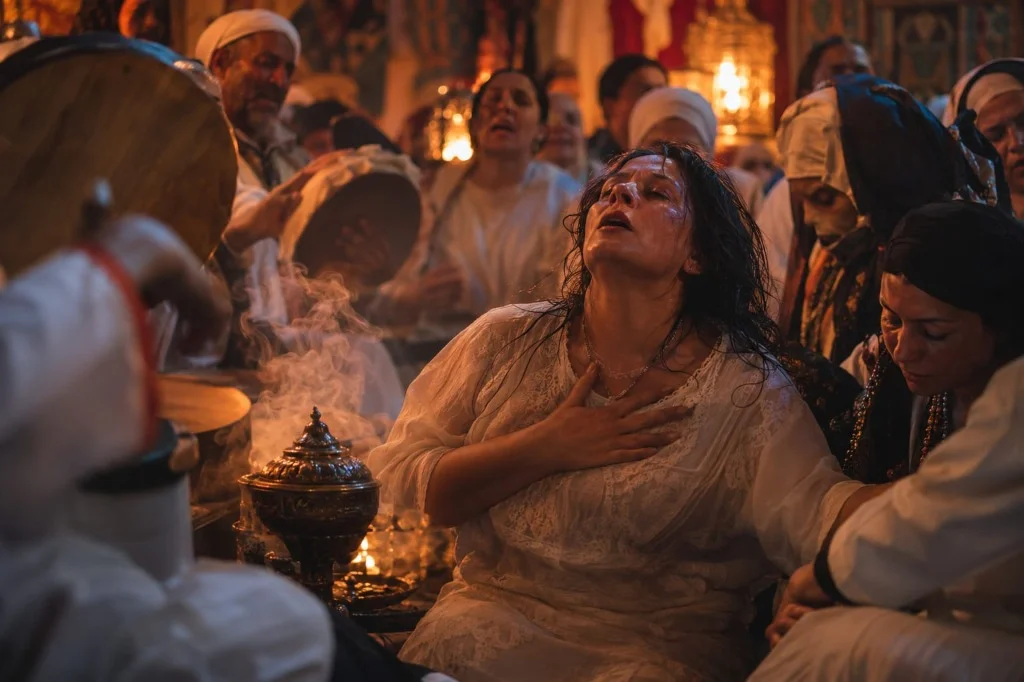
Behaviors that might be considered unusual or inappropriate in everyday life can become accepted forms of emotional expression.
Crying, shouting, trembling, or entering a trance may be understood as meaningful stages of the ritual rather than as conduct requiring immediate social disapproval.
The participant does not necessarily have to explain every detail of their personal history to receive attention.
Their presence and visible emotional responses may be enough for others to recognize that they are experiencing distress.
Musicians, ritual leaders, and fellow participants contribute to this process by maintaining the ceremony, accompanying emotional reactions, and offering assistance when someone appears overwhelmed.
Individual suffering becomes part of a shared experience.
This dimension can be considered alongside psychological theories of recognition and research on social support, belonging, and emotional regulation.
Jessica Benjamin's work on recognition, for example, offers a useful conceptual perspective on the importance of being acknowledged by others as a person whose subjective experience matters.
In my book, I describe hadra as a setting in which individual suffering can be reorganized into a collective narrative.
Participants arrive with different histories and difficulties, but the ritual offers a common language through which those experiences can be expressed.
The symbolic framework allows individuals to communicate emotional pain without necessarily disclosing its personal origins.
For someone who has experienced isolation or repeated invalidation, the opportunity to be witnessed and supported by a group may itself carry considerable emotional significance.
6 Music, movement, and the expression of difficult emotions
Music and bodily movement are central to the emotional experience of hadra.
Traditional chants, percussion, repeated gestures, and changes in rhythm contribute to an atmosphere that can become increasingly intense.
Some participants eventually enter jedba, a form of ecstatic movement associated with trance-like states and deep emotional absorption.
During my fieldwork, I observed differences in the emotional expressions accompanying musical sequences associated with particular l'mlouk.
The rhythms dedicated to Mimoun were frequently accompanied by expressions of sadness and experiences interpreted through the language of misfortune.
Sequences associated with Pacha Hammou appeared more closely connected to anger and frustration, including the accumulated resentment that Moroccan Arabic describes as l'feqsa.
The music associated with Mira seemed to provide a setting for tensions involving desire, while sequences dedicated to Sidi Moussa, whose songs evoke the sea, travel, and distance, drew my attention to experiences of separation and isolation.
Lalla Malika's sequences often had a more celebratory atmosphere and were sometimes performed toward the end of the ceremony.
The moments devoted to Lalla Aïcha were particularly striking.
They frequently involved intense crying, prolonged bodily movements, shouting, and expressions that I interpreted as belonging to a depressive emotional register.
These observations do not establish fixed psychological effects for particular rhythms or supernatural figures.
They suggest that musical experience within hadra is shaped by the interaction between sound, cultural expectations, personal associations, and the meanings attached to different ritual characters.
Participants do not encounter the music as an unfamiliar sequence of sounds. They often know the stories, colors, emotions, and symbolic associations connected to the figures being invoked.
The rhythms can therefore activate culturally learned expectations while interacting with individual emotional histories.
Bodily movement adds another dimension: motor expression.
A person who has difficulty expressing anger or grief verbally may find an alternative means of expression through repetitive movement, crying, or intense physical engagement.
The body becomes a visible medium for emotional experience.
Rhythmic repetition, collective participation, and the gradual intensification of the ceremony may facilitate states of absorption in which ordinary concerns temporarily recede.
Participants may experience this process as emotional release.
However, the intensity of a bodily reaction cannot, by itself, demonstrate that the psychological conflict associated with it has been resolved.
Emotional discharge may provide immediate relief while leaving the underlying relationships, circumstances, and psychological patterns unchanged.
This distinction between catharsis and lasting psychological transformation is essential when examining the therapeutic functions attributed to traditional rituals.
7 Niyya: belief, intention, and emotional openness
The Moroccan concept of niya, commonly translated as intention, occupies an important place in traditional explanations of hadra.
Participants may be encouraged to tsaffi niya, or clarify and purify their intention, before entering the ceremony.
Ritual practitioners often present this disposition as necessary for obtaining the desired benefits.
Yet my observations suggest that intention does not always involve unquestioning belief in the literal existence of supernatural beings.
Some participants who expressed skepticism outside the ceremony nevertheless became deeply emotionally engaged during the ritual.
One participant offered a particularly revealing account after a hadra session:
« It doesn't really matter whether Lalla Aïcha exists or not. What matters is that I felt something being released from inside me, something that had been suffocating me. »
This statement illustrates an important distinction between belief in a supernatural explanation and the subjective reality of an emotional experience.
The participant described a meaningful change in how they felt without requiring the literal existence of Lalla Aïcha to explain it.
Human beings can experience genuine emotions in response to narratives they recognize as fictional or symbolic.
Literature, theater, and cinema provide familiar examples of this capacity.
Hadra introduces additional dimensions through music, bodily participation, collective expectations, and the culturally established meanings of its characters.
From this perspective, niya may sometimes be understood as a willingness to participate in an experience that offers the possibility of relief.
Such willingness can interact with expectation, suggestion, and emotional engagement.
It also helps explain why participation in hadra cannot always be understood as straightforward evidence of firm supernatural belief.
A person may remain uncertain about the ritual's explanations while still finding the experience emotionally significant.
8 Baraka and the possibility of a different future
The psychological experience of hadra extends beyond the ceremony itself.
Participants often leave with expectations about how their lives might change.
The concept of baraka plays an important role in this process.
Within the ritual's symbolic framework, baraka represents a form of blessing, protection, or favorable influence that participants hope to receive and retain.
It may be associated with improved relationships, the end of misfortune, greater success, or relief from suffering.
Psychologically, this expectation can influence the way an individual approaches the future.
Someone who previously felt trapped in a cycle of failure may leave the ceremony with a renewed belief that change is possible.
The ritual can mark a subjective turning point, separating a period of suffering from an anticipated period of improvement.
This shift in expectations may affect behavior.
A participant might become more willing to initiate conversations, repair relationships, pursue opportunities, or approach previously feared situations.
The concept of hal, referring to a particular state of emotional and spiritual engagement during the ceremony, is also relevant.
Participants may describe experiences of absorption, calm, or emotional fullness that they interpret as signs of reconciliation with the forces invoked.
These experiences can be deeply meaningful without necessarily producing lasting changes in the circumstances that generated distress.
A person may feel temporarily relieved while continuing to face the same family conflicts, financial difficulties, or psychological vulnerabilities.
Furthermore, subsequent improvements may be attributed to baraka, reinforcing confidence in the ritual.
If difficulties return, the individual may interpret them as evidence that the blessing has been lost or that a supernatural force has become displeased again.
This interpretation can encourage repeated participation.
The same symbolic framework may therefore support hope in one situation and contribute to recurring fear or dependence on ritual practices in another.
Understanding these differences requires attention to each participant's history, expectations, and relationship with the beliefs involved.
9 The cultural familiarity of traditional healing
The continued appeal of hadra also raises broader questions about how people seek psychological support.
Individuals do not necessarily choose a form of help after comparing its methods or evaluating evidence of effectiveness.
Their decisions are influenced by family recommendations, social expectations, previous experiences, accessibility, and the cultural meanings associated with different practices. For individuals considering modern psychotherapy, our guide to the first psychological consultation helps clarify what to expect in professional settings.
Hadra draws on elements familiar to many participants: traditional music, religious references, stories passed down through generations, the symbolism of saints and spirits, and local expressions of suffering.
This familiarity can make the ritual feel accessible.
A person does not need to know psychological terminology to explain that life feels blocked by twaqef, that everything seems to be going wrong because of l'aks, or that they are searching for tbrad l'qelb.
These expressions belong to a cultural vocabulary through which emotional experience becomes understandable and communicable.
They may also reveal important aspects of a person's psychological world.
For example, a repeated reference to l'aks may express helplessness, frustration, or a conviction that personal efforts cannot change circumstances.
The desire for tbrad l'qelb may point toward a need for emotional relief, reconciliation, or freedom from accumulated resentment.
Exploring these meanings can help illuminate how individuals understand their difficulties and what they expect from those who offer assistance.
Such an approach is consistent with the concerns of cultural psychology and ethnopsychiatry, which examine how societies shape the interpretation, expression, and management of psychological suffering.
Understanding the cultural language of distress does not require accepting every explanation associated with it.
It requires taking seriously the experiences that people communicate through that language.
10 From hadra to psychodrama: what traditional rituals can teach us
One of the directions I explore in my book concerns the possibility of examining certain psychological functions of hadra through the framework of psychodrama.
Hadra contains several elements that lend themselves to this comparison.
It involves symbolic characters, emotionally charged relationships, enacted conflicts, bodily expression, and a group that witnesses and participates in the unfolding experience.
The ceremony also follows a dramatic progression.
Preparations establish the ritual setting, musical sequences gradually intensify emotional involvement, and moments of heightened expression may be followed by experiences of calm or reconciliation.
These characteristics bear functional similarities to aspects of psychodrama, in which individuals use enactment and role exploration to investigate psychological conflicts and interpersonal experiences.
Within a psychodramatic setting, participants may represent difficult relationships, explore alternative perspectives, and express emotions that have remained inaccessible through ordinary conversation.
Consider someone who expresses intense anger toward Lalla Aïcha during hadra.
A psychodramatic approach could provide opportunities to explore whether this symbolic anger is connected to unresolved experiences involving a parent, partner, or other emotionally significant person.
The symbolic character would become an entry point into the participant's personal history.
The aim would be to examine the meaning of the emotional conflict and the possibilities for changing the relationships or patterns through which it continues to operate.
This approach could preserve important expressive dimensions of the ritual, including movement, enactment, and collective participation, without requiring participants to adopt supernatural explanations.
It could also reduce the potential difficulties associated with narratives that reinforce fear of invisible punishment or create repeated obligations to perform ceremonies.
The comparison does not imply that hadra and psychodrama are equivalent practices.
Their purposes, theoretical foundations, and methods differ substantially.
The value of the comparison lies in identifying expressive and relational processes that may inspire culturally responsive forms of psychological work.
Traditional practices can be studied as repositories of collective experience concerning emotional expression, symbolic representation, and social support.
Examining these processes may enrich psychological thinking about how individuals communicate suffering and seek relief within their cultural environments.
11 Conclusion: understanding suffering through its cultural expressions
The continued use of hadra as a means of seeking psychological relief illustrates the close relationship between personal suffering and the cultural systems through which it becomes meaningful.
Participants may arrive with very different experiences: family conflict, emotional deprivation, persistent guilt, repeated disappointment, loneliness, or fear about the future.
The ritual offers a framework through which these difficulties can be interpreted, expressed, and shared.
Suffering acquires an explanation. Emotional conflicts find symbolic characters. The body becomes a medium of expression, while the group provides an environment in which distress can receive attention and recognition. For those seeking structured personal care, the directory of psychological care and listening professionals provides qualified guidance.
My fieldwork led me to regard these psychological and social functions as central to understanding the experience of hadra.
Focusing exclusively on its supernatural beliefs would overlook the emotional and relational processes taking place within the ceremony. Attributing universal therapeutic effectiveness to the ritual would be equally inadequate, particularly given the distinction between immediate emotional relief and sustained psychological change.
The central question concerns what participants actually experience.
How do they interpret their difficulties? Which emotional conflicts emerge through symbolic characters? What role do rhythm and bodily movement play in their expression? How does collective recognition influence their sense of suffering?
An equally important question concerns what happens after the ceremony.
Does the experience lead to changes in family relationships? Does it alter the person's understanding of their difficulties? Are new behaviors sustained, or do the same conflicts continue under a different explanation?
These questions help distinguish the emotional impact of a ritual from the longer psychological processes through which lasting change may become possible.
Hadra ultimately reveals something fundamental about the relationship between human suffering and culture.
People seek ways to express distress through the symbolic, social, and emotional resources available to them. Their language may take the form of mythology, music, bodily movement, religious imagery, or stories about supernatural beings.
Behind these forms of expression lie recognizable human experiences: fear of rejection, longing for protection, unresolved anger, the need for belonging, and the desire to restore a sense of control over one's life.
For psychology, understanding this language provides an opportunity to explore the personal and relational experiences that give it meaning.
It also invites a broader reflection on how psychological support can engage with cultural forms of expression while helping individuals develop a more sustained understanding of their suffering and the possibilities for change.