
1 Building a life abroad: achievement, loneliness and belonging
The early demands of migration can absorb much of a person's attention. Securing residency, finding work and housing, learning a language or completing an education become urgent priorities. Achieving these goals may bring considerable satisfaction, and relatives often celebrate them as signs that the move has worked out. Emotional adjustment also depends on relationships, the losses involved in leaving and needs that may have received little attention during those busy years.
Consider a Moroccan professional who has lived in Germany for ten years. He has a secure job, a reasonable income and a stable home. He supports his parents and visits Morocco whenever he can. His relatives see a successful life. Yet he has few close friends, finds work exhausting and is losing interest in activities he used to enjoy. When he mentions his unhappiness, they remind him how fortunate he is or compare his circumstances with those of family members struggling to find work.
These responses may be intended as reassurance. They can still make it harder to acknowledge distress, particularly when parents helped finance the move or invested their hopes in its success. The man may begin to feel that admitting dissatisfaction would disappoint those who supported him. Alongside the original difficulties, he now has doubts about whether he is entitled to feel unhappy at all.
Therapy can provide time to examine the expectations attached to migration, relationships that have changed, sacrifices made and needs that remain unmet. A psychologist familiar with Morocco may recognise the collective significance of migration in some families, including expectations of financial support. That knowledge needs to be tested against this person's circumstances: families differ in how they understand obligation, success and independence.
The timing of a request for help can be revealing. During the first years abroad, practical problems may leave little space for reflection. Once work and housing feel more secure, questions about friendship, intimacy or the direction of life can become harder to put aside. Someone who expected stability to bring lasting contentment may struggle to understand why it has not. Relatives may be equally puzzled, especially if they hear mainly about professional achievements and rarely see the person's ordinary days.
Exploring that experience gives the patient room to describe what has been gained and what remains difficult. A familiar neighbourhood, friendships or everyday family contact may have been important sources of comfort before the move. Building new connections can take time, and a demanding job does not necessarily provide the emotional support a person needs. The psychologist can examine these changes alongside current pressures, including discrimination, financial commitments and uncertainty about the future.
A sense of belonging can change over time too. In his 1999 book La double absence, Abdelmalek Sayad examined migrants' relationships with both their society of origin and the society in which they settled, drawing primarily on Algerian migration to France. His work offers a sociological starting point for thinking about these connections, while the differences between migration histories require care.
Visits to Morocco can make personal changes particularly noticeable. Someone looks forward to seeing old friends and relatives, then discovers that their interests have shifted and familiar relationships feel less close. Leaving may bring sadness alongside relief at returning to their usual routine abroad. In their country of residence, stereotypes about their name, appearance or family background may also leave them feeling that their belonging is repeatedly questioned.
Mixed feelings of this kind can be part of ordinary personal development across several social environments. Their intensity, persistence and impact on daily life help determine whether support would be useful. Discrimination, loneliness or family conflict may add to the strain. Therapy can help a person consider how they want to relate to their different backgrounds, including the pressure to choose a single identity or continually justify their choices.
Someone may want to remain close to relatives without sharing all their views. Another may feel comfortable with different parts of their life in different places, yet find other people's expectations difficult to manage. These positions can change as relationships and circumstances change. Giving them time in therapy allows the patient to describe what belonging means in practice: the relationships they value, situations in which they feel judged and choices they would like to make more freely.
People born abroad to Moroccan parents often have a different experience. Their connection to Morocco may develop through family stories, summer visits, languages, food, religious practices and relationships with relatives. School, friendships and everyday life have taken shape elsewhere. One young adult raised in the Netherlands may identify strongly with Moroccan heritage; another may feel less attached to it. Marie Rose Moro explores children's lives across cultural settings in Enfants d’ici venus d’ailleurs. Understanding the patient's own attachments and present surroundings matters more than expecting a particular relationship with their heritage.
For a therapist based in Morocco, this means taking a serious interest in the country where the patient grew up or now lives. Assumptions drawn from life in Morocco may miss the influence of school, work, friendships and local institutions. The patient's relationship with their parents' background also needs to be heard in their own terms. Some want to explore that connection more deeply; others want help with pressure to demonstrate an attachment that does not reflect their experience.
2 Language, cultural familiarity and feeling understood
Speaking comfortably at work or managing administrative tasks requires skills that may feel different from those needed in therapy. Describing a childhood memory, a painful relationship or a feeling rarely expressed can bring a person back to the language in which the experience occurred. Words learned from parents or grandparents may carry the tone of a conversation and the emotional meaning of the relationship as well as their everyday definitions.
Moroccan expressions such as hchouma, l’3ib, hogra or rda lwalidine illustrate this complexity. A woman living in Belgium might say she feels hchouma about divorcing her husband. In her circumstances, the word could involve fear of disappointing her parents, concern about family reputation, expectations of marriage or anxiety about being blamed for its breakdown. It might also reflect a belief learned in childhood that keeping a marriage together is her personal responsibility, however unhappy it becomes.
A psychologist familiar with these expressions may recognise possible meanings quickly. Understanding what the word means to this woman remains the next task. The same expression can convey respect in one family, fear of judgement in another, or memories of humiliation for a particular individual. Cultural knowledge becomes useful when it supports careful questions and leaves room for these differences.
The conversation might explore whose judgement she fears, what she expects her parents to say and how she herself feels about ending the marriage. Her concern about family reputation may sit alongside affection for her parents and a wish to protect her own wellbeing. Hearing these strands separately helps the psychologist understand a feeling that initially seemed captured by a single word. Familiar vocabulary provides an opening for that exploration rather than a complete explanation of it.
Some multilingual patients also move naturally between languages. They may describe an argument in French, repeat their mother's exact words in Darija and return to French to reflect on what happened. Keeping the original wording can preserve something important about the memory. For another patient, Amazigh may allow greater precision or emotional expression. The therapist needs sufficient proficiency in the languages used, and patients should feel free to choose. Someone raised in Spain or the Netherlands may find Spanish or Dutch more comfortable for discussing their inner life.
It is worth discussing these preferences before booking. Not every Moroccan psychologist speaks the same languages, and conversational fluency may not be enough for the detail required in clinical work. Patients need to be able to question an interpretation, explain an unfamiliar feeling and ask the therapist to clarify something. For people who use several languages, the most workable arrangement may allow movement between them without making that movement an obligation or treating one language as more authentic than another.
A review of 58 studies published in Health Policy in 2024, first available online in 2023, identified linguistic and cultural barriers in migrant and refugee mental healthcare. It highlighted the need for language support and cultural competence. These findings help explain access difficulties without determining the best language for any individual patient.
Familiarity may also reduce the effort involved in explaining family relationships. Someone may worry that frequent contact with parents will be interpreted too quickly as a lack of independence. Another may fear that the wider consequences of divorce will be overlooked. A knowledgeable therapist can make the initial conversation easier while still examining harmful pressure, coercion or violence and respecting the patient's freedom to decide.
The 2011 meta-analysis by Cabral and Smith helps distinguish expectations from outcomes. It found an average preference for therapists of the same racial or ethnic background, but a very small average effect of matching on treatment outcomes, with substantial variation across studies. It did not specifically examine the Moroccan diaspora.
Shared background may encourage someone to start therapy, while the value of the arrangement becomes clearer through the work itself. Psychologists in Morocco differ in training, approach and communication style. Some patients prefer direct questions and early agreement on goals; others need more time to explain their history. A therapist without Moroccan heritage may also provide suitable care through relevant clinical expertise and cultural sensitivity. Our guide to therapeutic approaches offers a starting point for discussing the methods a psychologist proposes.
Practising in Morocco can give a psychologist direct experience of changes in family life, expectations of young adults and attitudes towards mental healthcare. That experience may be helpful when a patient's difficulties involve relationships in both countries. A therapist also needs to understand the practical conditions that shape the patient's choices abroad, including their working life, access to healthcare and economic circumstances. Familiarity with one setting becomes more useful when accompanied by an informed interest in the other.
There is also room for the patient to challenge what seems familiar to the therapist. A professional may recognise a common family pattern and inadvertently overlook a difference that matters. Patients should be able to say that an explanation does not fit, that a particular obligation has a different meaning, or that they do not share the values being assumed. How the psychologist responds to such corrections can help establish whether the relationship allows enough freedom for the work ahead.
3 Family relationships across borders: responsibility, choices and privacy
Family ties can provide substantial emotional and practical support after a move abroad. Distance changes how people stay in touch and help one another, while expectations about money, marriage, work and parenting may remain influential. Difficulties can develop when these expectations conflict with the person's resources or plans, especially if changing an arrangement feels disloyal.
Imagine a Moroccan man in Belgium who has supported his parents and siblings for several years. He now wants to save for a home and prepare for marriage. Reducing his contributions seems reasonable, yet he feels intense guilt. His relatives helped with his education, and he sees his present stability as partly belonging to the wider family. Gratitude, indebtedness, concern for his parents and a need for independence become closely entangled. Therapy can help him decide what support he wants and can afford to maintain, and examine beliefs that make any financial limit feel morally unacceptable.
The arrangement may have developed gradually. What was manageable at one stage of his life may be harder to sustain as his own responsibilities grow. Looking at the family's current needs, his resources and the expectations attached to previous help can make the problem clearer. Even when a smaller contribution is financially necessary, the emotional difficulty may remain. He may need time to understand why disappointing relatives feels so threatening and what he believes a good son or brother should provide.
Marriage and separation can carry similarly complex consequences. A Moroccan woman in France considering divorce may worry about her children, financial or legal circumstances, her parents' reactions and relations between the two families. A man in Canada may want to marry someone whose religious background differs from his family's expectations. Understanding these decisions involves considering sources of pressure, possible harm, available support and realistic choices. A psychologist's professional independence protects the patient's right to decide, without promoting obedience, estrangement or a preferred model of marriage.
In these situations, a person may have a clear wish and still hesitate because of the relationships that could be affected. Exploring the anticipated consequences can reveal where dialogue seems possible, which limits matter most and what support is available if conflict develops. The therapist needs to recognise the emotional importance of the family without treating its expectations as instructions for the patient's life. Knowledge of social customs should help the person think through a decision in greater detail.
Caring for parents and facing bereavement from a distance
As parents grow older, illness or reduced independence may draw relatives abroad into increasingly demanding care arrangements. A daughter in Spain might organise her mother's medical appointments in Morocco, contribute to treatment costs, coordinate help from siblings and call every day. Despite these efforts, she may feel that she is never doing enough. The strain can intensify when her children, job and financial responsibilities also need attention.
Psychological support can help her examine the extent of her responsibility, the limits of her control and the source of persistent self-blame. Sharing duties or changing arrangements may become possible once these pressures are understood. Some people choose greater involvement; others need to reduce commitments that have become unsustainable. The work should leave room for different decisions based on the person's relationships, resources and wishes.
Distance can make uncertainty especially difficult. A delayed phone call or news of a medical appointment may leave the daughter anxious about what is happening and whether she should travel. She may judge herself against the imagined care she could provide if she lived nearby, while giving little weight to what she already contributes. Examining these thoughts alongside the actual division of responsibilities can help her understand both the care she wants to offer and the exhaustion she is experiencing.
Bereavement can bring particular pain when someone cannot reach Morocco in time for a relative's final days or funeral. Missing family rituals and being separated from others who are grieving may intensify sadness, regret or a sense that the death does not feel real. Support can help the bereaved person explore their relationship with the person who died, the significance of the missed rituals and the place of family memories in mourning.
Finding enough privacy to speak openly
Some families associate psychological treatment with severe psychiatric illness, while others believe marital or emotional problems should remain within the household. These attitudes vary with generation, knowledge, social circumstances and personal experience. They should not be assumed to characterise Moroccan culture as a whole. Within a small community, however, overlapping family, work and social networks can make the possibility of personal information circulating particularly worrying.
A previous disappointing experience of care may add another reason for hesitation. Someone may be concerned about being judged, misunderstood or encouraged towards a decision they do not want. Such concerns deserve discussion at the start, including what the patient expects from confidentiality and professional independence. The choice of a Moroccan psychologist may feel reassuring to one person and too close to family life for another. Both reactions need to be understood in the context of the individual's history.
Seeing a psychologist in Morocco who has no connection to that network may feel more discreet. Actual confidentiality depends on professional conduct, information handling, digital security and the therapist's independence. Any existing relationship with the patient's relatives needs consideration if it could create a conflict of interest. The patient should understand the limits of confidentiality and the practical arrangements for keeping conversations private; geographical distance alone cannot provide those safeguards.
4 Difficulties that may lead someone to seek help
Moroccans abroad seek psychological support for many reasons. Some concerns are closely connected to migration; others occur across populations regardless of origin or residence. An assessment needs to consider symptoms, their duration and impact, the person's history and present circumstances, without treating culture as an automatic explanation for distress.
Work demands, administrative uncertainty, financial insecurity and family responsibilities can sustain stress. Disturbed sleep, persistent worry, irritability, tension or difficulty concentrating may become hard to manage. Loneliness can persist despite an active working life, particularly when relationships offer little emotional closeness. Low mood, loss of interest, reduced energy or feelings of worthlessness deserve assessment when they continue or interfere with daily life. Severe depression may require medical evaluation and coordinated local care.
An assessment can explore when the difficulties began, what seems to intensify them and how they affect work, relationships and ordinary routines. This helps connect concerns that the patient may initially describe separately, such as poor sleep, repeated worry about relatives and withdrawal from friends. It also provides a basis for discussing the aims of treatment and the kind of support needed. The clinician's experience with the particular problem matters alongside their familiarity with migration.
Migration can also alter a couple's established roles. One partner may gain economic independence while the other struggles with employment, language or social integration. Disagreements can develop over household responsibilities, parenting, support for relatives or the influence of extended family. Individual or couples therapy may be appropriate depending on the circumstances and the professional's expertise. Where abuse, threats or coercive control are present, safety assessment and specialist support take priority; couples therapy may be inappropriate or unsafe.
Conflicts over education, religion, career choices, romantic relationships or ways of living can bring people to therapy too. Such disagreements are not themselves evidence of mental illness. Support may be helpful when pressure, guilt or anxiety become persistent and painful, or relationships deteriorate. It can provide room to examine values and decisions while considering their consequences for important relationships.
Parents may also seek help with bilingual upbringing, children's relationships with grandparents, religious or cultural transmission, and differences between expectations at home and school. Work with the family can improve communication, clarify developmental needs and distinguish ordinary disagreements about parenting from difficulties requiring specific assessment. For children and adolescents, the choice of care must take account of age, main language, ability to engage through video, family involvement, consent, privacy and possible coordination with schools or local professionals.
Understanding a young person's circumstances requires attention to all the settings in which they spend time. Parents may describe worries about cultural transmission, while the child has concerns shaped by school or friendships. The professional needs enough knowledge of both to understand where communication has become difficult. If useful assessment or support depends on close contact with local services, that requirement should form part of the decision about remote care from the outset.
5 What online therapy makes possible, and what the evidence shows
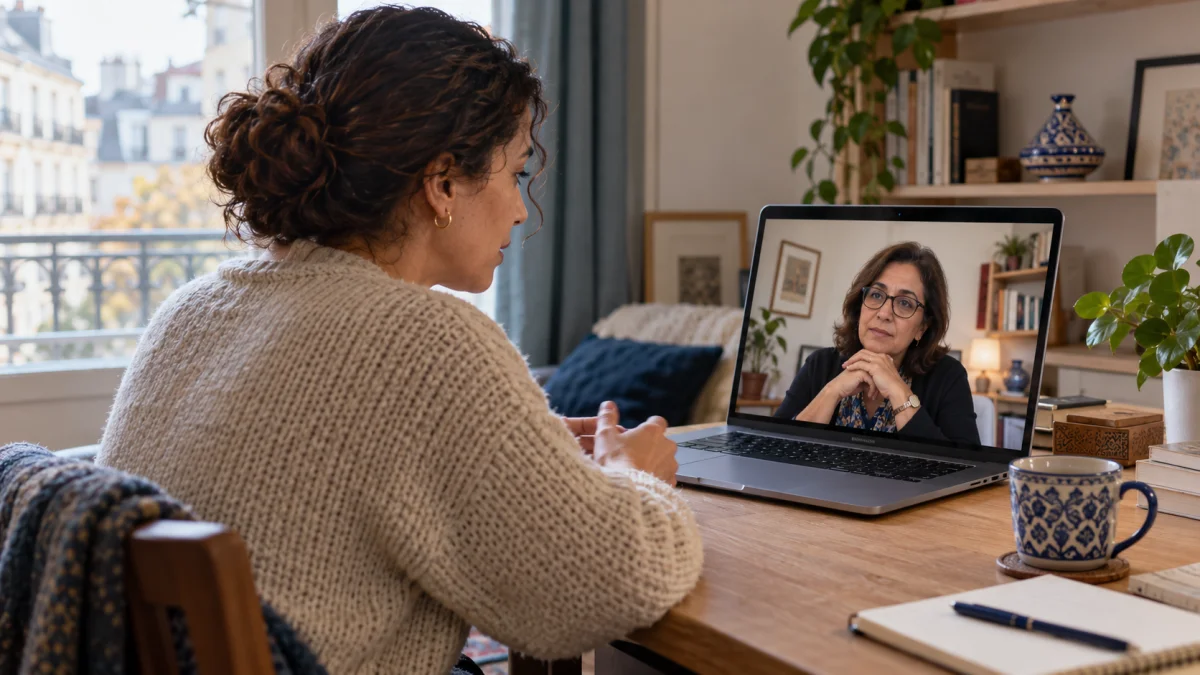
A person in a small German town may struggle to find a therapist with both the language skills and clinical experience they need. Irregular shifts, childcare or lengthy journeys can also make appointments difficult. Video sessions widen the search and remove travel time, potentially making regular attendance easier. Their usefulness still depends on a quiet, private space, reliable technology and time that can be given fully to the appointment.
Practical convenience has to be considered in the patient's actual home and working life. A parent in France may save a journey yet still need someone to look after the children. A professional in the Netherlands may find a suitable appointment time but need somewhere private to speak. Regular attendance becomes more realistic when these details are discussed alongside availability. A session should allow sustained attention to difficult subjects without the patient remaining responsible for competing tasks throughout the conversation.
Online care can sometimes preserve continuity through travel or relocation. Someone might begin therapy during a visit to Morocco and wish to continue after returning to Spain, or move between cities for work. These arrangements need discussion before the move, including whether remote care remains suitable and permitted from the new location. Where those conditions are met, keeping the same psychologist can preserve the relationship and work developed over previous months.
Cost can influence the decision as well. Fees vary with location, qualifications, appointment length and the service offered. Some patients find a psychologist in Morocco whose fees fit their budget. A useful comparison includes the frequency of appointments, international payment charges, exchange rates and possible insurance reimbursement in the country of residence. The overall cost and the professional's suitability for the difficulty matter more than the price of a single session.
Reading the findings with their limits in mind
A 2024 CMAJ meta-analysis covering 54 trials and 5,463 participants found little or no average difference between therapist-guided remote and in-person cognitive behavioural therapy (CBT), with moderate certainty. The remote interventions used several delivery methods, so this finding does not relate exclusively to live video appointments.
A 2026 review in the Journal of Medical Internet Research focused on video psychotherapy, including 12 trials and 900 participants. It found no statistically significant difference in symptom reduction, but rated the evidence as low certainty. Variation between studies and their concentration on selected treatments and populations limit generalisation.
These findings support considering remote care after an individual assessment. They do not establish that every online service is effective or that video suits every patient. The difficulty being addressed, the treatment method, the therapist's training and the conditions of care all need attention, with scope to change the arrangement if it is not working well.
The therapeutic relationship also requires practical care. Patients need to understand the goals, feel heard, express reservations and discuss what is helping or getting in the way. Video conveys facial expressions and tone of voice while limiting some other observations. Delayed sound, connection failures, camera positioning or people nearby can disrupt a conversation. Agreeing on a backup plan and allowing time after emotionally demanding sessions can make the arrangement more manageable. Patient and therapist should be able to revisit these conditions throughout treatment.
6 Choosing a psychologist and arranging care across borders
Language and familiarity with Morocco may provide a starting point for the search. Qualifications, experience with the difficulty being addressed and the proposed approach help narrow it down. Psychologists, psychiatrists, psychotherapists and coaches can have different training, responsibilities and legal status depending on the country. Patients should be able to clarify a professional's exact title, qualifications and relevant experience. Our guide to a first mental health appointment also explains how to talk about concerns and discuss the next steps.
Cross-border services require checks beyond the ability to make a video call. Applicable rules may depend on the therapist's location, the patient's physical location, qualifications and the type of work involved. Requirements can also vary between regions or provinces within a country. A qualification recognised in Morocco does not automatically authorise every form of treatment for people elsewhere. The professional should be able to explain the basis for providing the service, checks made and any limits on continuing care internationally.
The American Psychological Association's telepsychology guidelines, approved in 2024, address these professional issues. They provide US professional guidance; the rules applicable in Morocco and in the patient's location still require separate verification.
Protecting information and planning access to local help
Before treatment begins, patients should understand which platform will be used, how information is stored, who can access it and the limits of confidentiality. Any recording requires appropriate information and consent under the applicable rules. A widely used communication app cannot be assumed to meet all data protection requirements simply because it is familiar. The patient's surroundings also need to allow private conversation without being overheard or interrupted.
An acute psychiatric crisis, imminent suicide risk or urgent medical need may require immediate local intervention. The care arrangement should address referral to nearby services, the professional's availability between appointments and what to do if the patient's condition deteriorates. Anyone in immediate danger should contact emergency services in the country where they are physically present. When clinically indicated and legally permitted, online therapy may be coordinated with local medical or psychological care.
Insurance coverage needs checking before relying on it. In France, Mon soutien psy involves participating psychologists and an initial in-person assessment; follow-up video sessions are possible under specified conditions. Appointments with a psychologist based in Morocco are therefore not automatically covered. In each country, the insurer or supplementary provider should confirm whether international consultations are eligible for reimbursement.
The first conversations should clarify the languages the psychologist can work in, the approach, goals, session frequency and length, fees, payments and cancellation terms. These details allow patients to judge the arrangement and raise concerns. They should feel able to ask for explanations, review the goals or seek another professional if the care does not meet their needs.
The first appointment also gives the patient a sense of how the psychologist listens and responds. Does the professional ask about the circumstances behind a difficulty? Are explanations understandable? Can the patient mention a concern about the proposed approach or correct something that has been misunderstood? These exchanges provide more useful information about compatibility than nationality alone. They also help establish whether the patient can take an active part in deciding what the work should address.
For someone starting therapy during a visit to Morocco, the return abroad needs to be part of that early discussion. The professional may need to reconsider authorisation, access to nearby help and the suitability of the patient's surroundings after the move. When the patient is a child or adolescent, family involvement and consent arrangements need particular attention. Discussing these matters before regular treatment begins makes its practical possibilities and limits clearer to everyone involved.
A psychologist in the country of residence may offer in-person appointments, closer knowledge of local institutions and easier coordination with nearby services. A professional in Morocco may have language skills or cultural experience that a patient particularly values. A psychologist of Moroccan heritage practising locally is another possibility. The MarocPsy directory can provide a starting point for exploring profiles; the actual availability and conditions of international care need confirmation with each professional.
People differ in the relationship they want with Morocco and with their families. Some wish to strengthen those ties, while others need to reorganise them or reduce commitments that have become burdensome. Appropriate therapy makes room for these differences, helping each person understand their experience and consider their decisions within the life they are actually living.